
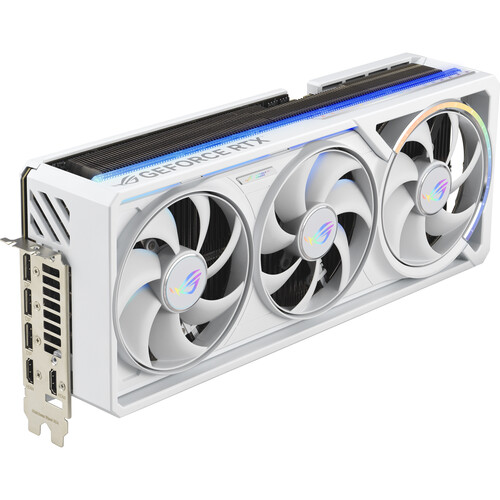
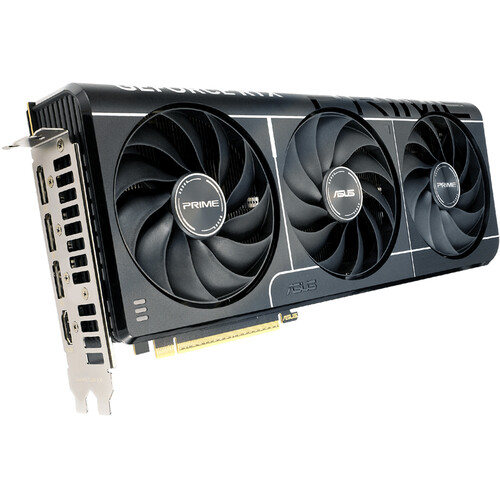
ASUS GeForce RTX 5080 PRIME EVO OC Graphics Card Overview
Based on NVIDIA Blackwell architecture, the ASUS GeForce RTX 5080 PRIME EVO OC Graphics Card brings real-time ray tracing and AI-powered performance to gaming and creative workflows. It features 16GB of GDDR7 memory, a 256-bit memory interface, and 10,752 CUDA cores for demanding applications. With an overclocked boost clock of up to 2685 MHz, the RTX 5080 supports high-resolution gaming, 3D rendering, video editing, and other GPU-intensive tasks.
The card includes DisplayPort 2.1 and HDMI 2.1 connectivity for high-resolution displays. Its CUDA cores also accelerate compatible applications and computational workloads through CUDA and other GPU APIs.
Triple Axial-Tech Fan Cooling
The PRIME EVO OC uses three Axial-Tech fans with longer blades to improve airflow and cooling. A vapor chamber and heatsink help absorb and dissipate heat, while the vented backplate promotes additional airflow. ASUS MaxContact technology and a phase-change GPU thermal pad further support thermal performance. Its 2.5-slot design also makes the card suitable for compatible small-form-factor builds.
Powerful AI and Creative Performance
GeForce RTX 50-Series GPUs accelerate generative AI, video editing, 3D rendering, and design applications. Compatible software can use RTX acceleration for real-time rendering, complex animations, AI-enhanced denoising, and other demanding creative tasks. Applications include Autodesk 3ds Max, Maya, Cinema 4D, and Blender.
Video Editing and Motion Graphics
RTX 50-Series GPUs introduce enhanced NVIDIA encoding and decoding capabilities, including support for 4:2:2 professional color formats, multiview HEVC, and AV1 Ultra High Quality mode. Tensor Cores accelerate AI-powered effects, while GPU processing helps streamline high-resolution editing and color grading in applications such as Adobe Premiere Pro, DaVinci Resolve, and REDCINE-X PRO.
Photography and Graphic Design
GPU acceleration improves performance in creative applications such as Adobe Photoshop, Lightroom Classic, Illustrator, and Adobe Substance 3D Stager. RTX-powered features help speed up image enhancement, masking, sharpening, RAW processing, vector graphics, and 3D visualization.
NVIDIA Blackwell Architecture
NVIDIA DLSS 4
DLSS 4 uses AI-powered neural rendering to increase frame rates, reduce latency, and improve image quality. It introduces Multi Frame Generation, enhanced Ray Reconstruction, and Super Resolution, powered by fifth-generation Tensor Cores.
Full Ray Tracing and Neural Rendering
NVIDIA Blackwell architecture combines fourth-generation RT Cores and fifth-generation Tensor Cores to deliver realistic lighting, reflections, and shadows through full ray tracing and neural rendering technologies.
NVIDIA Reflex 2
NVIDIA Reflex reduces system latency for more responsive gameplay. Reflex 2 introduces Frame Warp, which uses the latest mouse input to further reduce latency and improve responsiveness in supported games.
NVIDIA G-SYNC
G-SYNC helps deliver smooth, tear-free gameplay at high refresh rates while supporting HDR for compatible displays.